Workflow / Creator ToolsFeatured

Creative Lifecycle Management System

A personal creator workflow from spark to release

I built this first for myself because I was tired of watching ideas die in scattered notes. It connects capture, shaping, publishing, and review into one path I can actually stay inside.

  • Capture
  • AI
  • Publish
  • Diary
FeaturedWeb AppLiveWebCreated 2025-10-30Updated 2026-04-04
Creative Lifecycle Management System cover

Overview

What shaped the work

Outcome

Results and impact

  • Reduced switching cost from idea to publication through one primary path.
  • Created a reusable workflow skeleton that can evolve into broader product forms.

Decision

Key decisions and tradeoffs

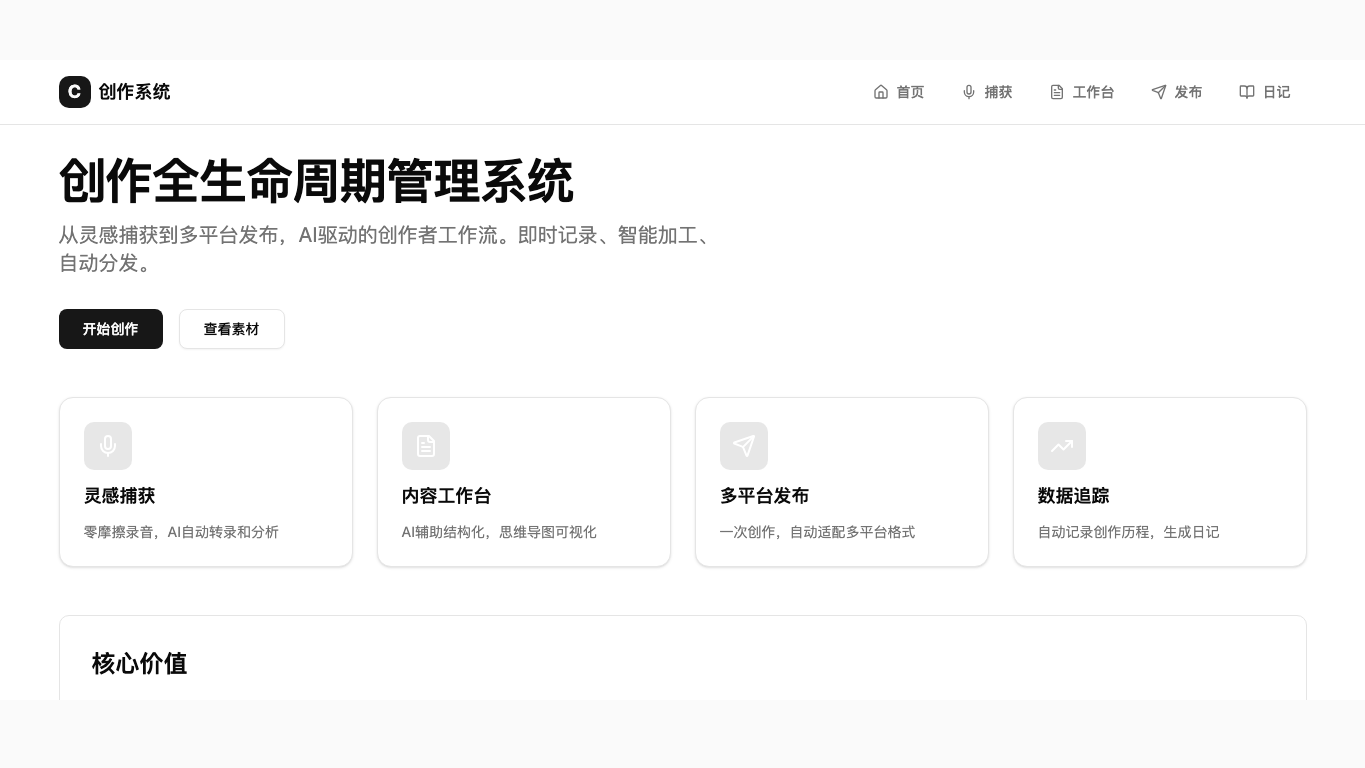
  • Adopted a four-stage IA: Capture / Workshop / Publish / Track.
  • Prioritized workflow closure before deepening module-level features.

Evidence

Evidence and proof

  • Live entry: https://creation.zondev.top/.
  • Public UI validates four-stage navigation and layered workflow architecture.

Visual history

Latest state first, previous interface states preserved underneath

This timeline keeps a readable visual memory of the surface, so the newest cover can stay on the project card without erasing what came before.

Case study

Narrative, decisions, and proof

01

Outcome

Results and impact

  • Reduced switching cost from idea to publication through one primary path.
  • Created a reusable workflow skeleton that can evolve into broader product forms.

02

Decision

Key decisions and tradeoffs

  • Adopted a four-stage IA: Capture / Workshop / Publish / Track.
  • Prioritized workflow closure before deepening module-level features.

03

Evidence

Evidence and proof

  • Live entry: https://creation.zondev.top/.
  • Public UI validates four-stage navigation and layered workflow architecture.

04

Role

Role and contribution

  • Owner / Design Engineer: abstracted real creator workflows into product structure and shipped an end-to-end demoable system.

05

Problem

Problem to solve

  • Creator pipelines often fracture between capture, processing, and multi-channel publishing, causing heavy repetition.

06

Constraints

Constraints and boundaries

  • Needed to solve a real personal high-frequency flow first, then generalize it into a shareable product model.
  • Had to keep information density high without increasing UX friction.

07

Background

Why this exists

The hardest part of creation is not writing itself but the broken chain from idea to publication. Inputs scatter, processing is slow, and distribution repeats.
08

Scenario

Use scenarios

  • Capture raw ideas quickly through text or voice.
  • Transform drafts into structured publishable assets.
  • Distribute once and adapt across multiple channels.

09

Delivery

What I shipped

  • Clear stage navigation: Capture, Workshop, Publish, and Track.
  • Core value modules for instant capture, AI shaping, and automated distribution.
  • Card-style entry system for creator-specific modules.

10

Design

Design decisions

  • Use workflow stages as information architecture.
  • Prioritize low-friction transitions and remove repeated manual steps.

11

Tech

Implementation

  • Modular routes and state architecture
  • Extensible model for structured content and channel outputs

Flow

The path from entry to completion

This version is best understood as a living product: entry points, feedback loops, and completion states matter as much as the surface design.

Capture / Workshop / Publish / Track

Creative Lifecycle Management System flowCaptureWorkshopPublishTrack

Explore

Open the product in context

Creative Lifecycle Management System cover

Live preview

Some sites may block iframe embeds because of their security policy. If the frame stays blank, use the Open live link above.

Access

This entry is still part of a living practice. The public surface may be a live URL, a guided preview, or a curated set of interface states depending on the current release shape.